SUSTAINABLE AND GREEN FUTURE: TACKLING CLIMATE CHANGE TOGHETER
Empowering minds to shape a greener tomorrow
Portalegre Polytechnic University, Portugal
Online Sessions: 16-20 March 2026
In-Person Session: 13-17 April 2026
Climate Changes
Climate change and environmental degradation pose a present threat to the present and future of humanity and all living beings. To address these challenges, the European Union approved a European Green Deal that aims to make Europe climate-neutral by 2050, boost the economy through green technologies, create sustainable industry and transport, reduce pollution, and prevent biodiversity loss. Environmental literacy and individual and collective action are crucial to encourage society to take decisive action to mitigate climate change and end the degradation of the environment and ecosystems. With the goal of acquiring the skills necessary to build a more sustainable economy and society, the aim is to equip participants with the necessary knowledge and skills regarding ecological and environmental transformation, promoting an understanding of sustainability and the diversity of actions that will facilitate the decision-making processes necessary to implement and participate in long-term structural change.
The course will be structured into four basic components: (1) Understanding climate change, its drivers, and agents; (2) Reducing the carbon footprint and storage, promoting energy efficiency, sustainable transportation, water reuse, agriculture, and sustainable land use; (3) Economic aspects of climate change (Green economy and sustainable development – Economic policies, environmental taxes and carbon taxes, green finance, sustainable business models. Circular economy and waste management – Strategies for waste reduction, recycling, and sustainable use of resources). Carbon markets and climate finance – Mechanisms such as carbon trading, green bonds, and ESG investment). (4) Governance and public policies (Multilevel governance and collaborative governance).
This BIP aims to explore these topics in some depth, so that participants can acquire a holistic understanding of the various fronts of action and possibilities for combating climate change and their implementation in daily practice. Participants will develop skills in cognition, critical thinking, integrated problem-solving skills, and a strategic mindset that will prepare them to actively intervene as citizens in the future of society and a healthier and more harmonious planet.
ABOUT THE EVENT
Portalegre Polytechnic University organizes this blended program on “Sustainable and Green Future: Tackling Climate Changes Togheter – Empowering minds to shape a greener tomorrow“, employing a multifaceted educational approach to deliver a comprehensive learning experience. By integrating online modules, interactive workshops, practical exercises, and project-based applications, the program ensures that participants understand the subject matter deeply and develop the skills needed to drive meaningful transformation in their organizations.
Target Audience and Credits
The BIP target audience includes late Bachelor’s and early Master’s students in Business and Economics or similar programs with sustainability and/or climate change and mitigation issues components. The BIP is worth 3 ECTS.
Program
Online Program
The online program will consist of remote sessions providing background content needed for the field work. It will comply of 2 hours each day, from 17h00 to 19h00 (GMT).
Online Session 1, 17 March, 2026, 17h00 (GMT)
Speaker: Prof.
Theme:
Link
Online Session 2, 18 March, 2026, 17h00 (GMT)
Speaker: Prof.
Theme:
Link
Online Session 3, 19 March, 2026, 17h00 (GMT)
Speaker: Prof.
Theme:
Link
Online Session 4, 20 March, 2026, 17h00 (GMT)
Speaker: Prof.
Theme:
Link
Online Session 5, 21 March, 2026, 17h00 (GMT)
Speaker: Prof.
Theme:
Link
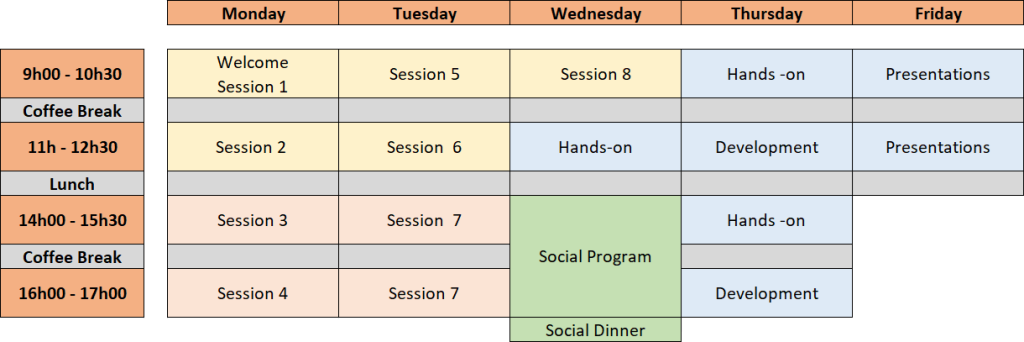
In-person Program (13-17 April 2026)
Monday, 13th April 2026
09:00-10:30
Welcome and Session 1
10:30-11:00
Coffee Break
11:00-12:30
Session 2
12:30-14:00
Lunch
14:00-15:30
Session 3
15:30-16:00
Coffee Break
16:00-17:00
Session 4
Tuesday, 14th April 2026
09:00-10:30
Session 5
10:30-11:00
Coffee Break
11:00-12:30
Session 6
12:30-14:00
Lunch
14:00-15:30
Session 7 – Part 1
15:30-16:00
Coffee Break
16:00-17:00
Session 7 – Part 2
Wednesday, 15th April 2026
09:00-10:30
Session 8
10:30-11:00
Coffee Break
11:00-12:30
Hands On – Projects Announcement
12:30-14:00
Lunch
14:00-17:00
Social Program
19h30
Social Dinner
Thursday, 16th April 2026
09:30-10:30
Hands-On – ProjectDevelopment
10:30-11:00
Coffee Break
11:00-12:30
Hands-On – ProjectDevelopment
12:30-14:00
Lunch
14:00-15:30
Hands-On – ProjectDevelopment
15:30-16:00
Coffee Break
16:00-17:00
Hands-On – ProjectDevelopment
Friday, 17th April 2026
09:30-10:30
Hands-On – ProjectPresentations
10:30-11:00
Coffee Break
11:00-12:30
Hands-On – ProjectPresentations
Session 1, Monday, 13th April, 9h00 to 10h30 (Local Time)
Theme: Understanding climate change, factors and agents
Lecturer: Prof. Ana Loures.
Abstract: This session proposes an integrated analysis of climate change as a physical, territorial, and social phenomenon, addressing the main processes that regulate the climate, the factors that have intensified global warming, and the agents involved in its production and transformation. Based on the scientific foundations of the climate system, the relationships between human activities, territorial organisation, development models, and exposure to climate risks will be explored. Particular attention will be given to mitigation and risk reduction strategies, including spatial planning, infrastructure adaptation, ecosystem management, and planning and governance mechanisms. The role of institutions, communities, and individuals in risk prevention, communication, and management will also be discussed. The session aims to promote a critical and applied understanding of climate dynamics, oriented towards the construction of more resilient and sustainable territories.
Session 2, Monday, 13th April, 11h00 to 12h30 (Local Time)
Theme: Reducing carbon footprint and storage, promoting energy efficiency
Lecturer: Prof. Maria Isabel Borges.
Abstract: Environmental literacy is essential for building and developing a society that is actively engaged in the sustainability and environmental health of the planet. It involves understanding and interpreting the balance of environmental systems and identifying appropriate actions to maintain, restore, or improve their health. To make this feasible, knowledge and comprehension of environmental concepts, problems, and issues are required (Spínola, H., 2016). Within this broad field, pollution resulting from anthropogenic carbon dioxide emissions has received increasing attention. It is therefore crucial to disseminate knowledge regarding CO₂ emissions, capture, utilization, and storage.
The lecture aims to address the following questions: what carbon capture, utilization, and storage consist of; how these processes relate to bioenergy; and how direct air capture operates. It also offers an overview of the current global status of carbon capture, with reference to the position of the European Union member states. Students will acquire the knowledge necessary to understand how CO₂ concentrations can be mitigated and to assess the European Union’s position on this issue.
Session 3, Monday, 13th April, 14h00 to 15h30 (Local Time)
Theme: Investing in sustainability: Applying financial valuation methods to circular economy projects
Lecturer: Prof. Desislava Stoilova
Abstract: The lecture explores how traditional financial valuation methods can be adapted to support investment decisions in circular economy projects. It examines the specific financial characteristics of sustainability-oriented investments, including long-term value creation, resource efficiency, and risk mitigation associated with environmental and social impacts. The session discusses the application of key valuation techniques based on discounted cash flows (DCF), such as net present value (NPV), internal rate of return (IRR), profitability index (PI), and payback period (PBP), within the context of circular business models. Particular attention is given to incorporating non-financial benefits, regulatory factors, and uncertainty into financial assessment frameworks. Through practical examples, the lecture highlights how investors, policymakers, and project managers can better evaluate the economic viability of circular initiatives while aligning financial performance with sustainability objectives.
.
Session 4, Tuesday 14th April, 16h00 to 17h30 (Local Time)
Theme: Economic aspects of climate change: Effects of carbon taxes on EU economic growth
Lecturer: Prof. Stoyan Tanchev
Abstract: The main focus of the lecture is to explain the nature of climate change. The lecture is divided into two parts. The first part examines and explains what climate change is and how it affects global warming. The causes of climate change and global warming are also discussed. The lecture examines how climate change affects countries’ economies and the negative effects of climate change. It also examines the measures and policies taken by European Union member states to tackle climate change. The second part of the lecture presents an empirical study using panel data. It analyses the relationship between carbon tax revenues and economic growth in EU countries. The results of the applied econometric model confirm a relationship between carbon tax revenues and economic growth in EU countries.
.
Session 5, Tuesday, 14th April, 9h00 to 10h30 (Local Time)
Theme: Another view on environmental pollution: globalization and sustainability effects in non-productive industries
Lecturer: Svetlana Polovko-Valtere.
Abstract: This lecture explores different points of view on environmental pollution – it shows that not only is classic industrial pollution dangerous for our green future. We will discuss information, culture, mass media, and tourism, and the lecture highlights specific types of pollution that can have a strong negative effect on the implementation of green policies and a sustainable future.
.
Session 6, Tuesday, 14thApril, 11h00 to 12h30 (Local Time)
Theme: Circular economy and waste management – Waste reduction strategies, recycling, and sustainable use of resources
Lecturer: Prof. Kaie Eha.
Abstract: This lecture introduces the principles of the circular economy and their application in modern waste management. The focus is on waste reduction strategies, including prevention, eco-design, reuse, and responsible consumption, as well as on recycling systems and technologies that enable the recovery of materials and energy from waste streams. The lecture examines how resources can be used more efficiently and sustainably throughout their life cycle, highlighting the environmental, economic, and social benefits of circular approaches compared to linear “take–make–dispose” models. Students will gain an understanding of the roles of policy, innovation, and individual behavior in supporting circular-economy practices and sustainable resource management.
Session 7, Tuesday, 14thApril, 14h00 to 17h00 (Local Time)
Theme: Carbon markets and climate finance – Mechanisms such as carbon trading, green bonds, and ESG investment
Lecturer: Prof. Kaie Eha.
Abstract: Carbon markets and climate finance play a central role in building a sustainable and green future by directing investment toward climate solutions. This lecture provides a concise introduction to key mechanisms, including carbon trading, green bonds, and Environmental, Social, and Governance (ESG) investing. Students will learn how carbon pricing creates incentives to reduce emissions, how green bonds finance climate-friendly projects, and how ESG criteria are reshaping investment decisions worldwide. Using international examples, the lecture highlights both the opportunities and challenges of using financial markets to tackle climate change. Designed for an intensive international course, the session equips students with the basic tools to understand how finance and climate action are increasingly connected.
Session 8, Wednesday, 15thApril, 9h00 to 10h30 (Local Time)
Theme: Governance and public policies – Multi-level governance and collaborative governance
Lecturer: Prof. Alla Iļjina.
Abstract: This lecture explores the role of governance and public policies in advancing sustainable development and addressing climate change within the framework of a green, sustainable future. It focuses on multi-level governance, examining how climate and sustainability policies are coordinated and implemented across local, national, regional, and international levels. The lecture also highlights collaborative governance approaches, emphasizing the importance of cooperation among governments, public institutions, civil society, the private sector, and communities in tackling complex environmental and climate-related challenges. Particular attention is given to policy coherence, stakeholder engagement, and shared responsibility in the design and implementation of effective climate actions. By integrating governance theory with sustainability-oriented examples, the lecture equips students with an understanding of how inclusive and coordinated governance systems can empower societies to shape a greener, more resilient, and climate-conscious future.
APPLICATION TIMELINE November 30, 2025 – Application period closed December 1-10, 2025 – Selection of the students December 11, 2025 – Announcement of the selected student
Please download the Info Pack files with all the information to get to us, choosing where to stay, where to eat, where to have a drink, and what to visit in the city and the surroundings.